Partner Marie-Anne Colson-Malleville
Queer Places:
Cimetière du Père-Lachaise, Paris, Département de Paris, Île-de-France, France
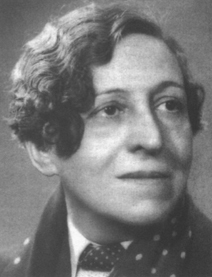 Germaine Dulac (November 17, 1882 – July 20, 1942) was a pioneering French filmmaker, film theorist, journalist, and activist whose artistic and
intellectual contributions laid the foundation for narrative impressionism, surrealist cinema, and the French Avant-Garde.
Germaine Dulac (November 17, 1882 – July 20, 1942) was a pioneering French filmmaker, film theorist, journalist, and activist whose artistic and
intellectual contributions laid the foundation for narrative impressionism, surrealist cinema, and the French Avant-Garde.
Born Charlotte Elisabeth Germaine Saisset-Schneider in Amiens, France, on November 17, 1882, to an upper-middle-class military family, she spent much
of her youth living with her grandmother in Paris due to her father's frequent relocations. Her grandmother introduced her to Parisian intellectual life,
fostering her early passions for music, painting, photography, and theater—disciplines that would later heavily influence her cinematic philosophy of
"pure cinema," which viewed film as a visual symphony governed by movement and rhythm.
In the early 1900s, Dulac embarked on a career in journalism and political activism, establishing herself as a prominent voice in French socialist and
feminist circles. Between 1906 and 1913, she worked as a theater critic and writer for radical feminist publications such as La Fronde and La Française,
advocating for women’s social emancipation, suffrage, and economic independence. In 1905, she married Louis-Albert Dulac, a progressive agricultural
engineer who supported her political writing and intellectual autonomy.
Dulac’s turn to filmmaking occurred during a 1914 trip to Italy alongside the dancer and actress
Stasia Napierkowska. Mesmerized by the artistic possibilities of the camera, Dulac co-founded her own
production company, Les Films DH, in 1916 alongside writer and editor Irène Hillel-Erlanger. Dulac
initially directed commercial melodramas before transitioning to experimental narrative forms. Her 1923 film La Souriante Madame Beudet (The Smiling
Madame Beudet) is widely celebrated as one of the earliest feminist films in history, utilizing slow motion, distortion lenses, and subjective editing to
depict the internal psychology and desires of a woman trapped in a suffocating bourgeois marriage. In 1928, she directed La Coquille et le Clergyman (The
Seashell and the Clergyman), based on a scenario by Antonin Artaud. Released prior to
Salvador Dalí and Luis Buñuel’s Un Chien Andalou, it is historically recognized as the first Surrealist
film.
Alongside her filmmaking, Dulac became a premier film theorist, championing Cinéma Pur (Pure Cinema), an approach that sought to liberate the medium
from theatrical conventions and literary plots by prioritizing light, rhythm, and visual movement. She directed several visual études set to classical
music, including works inspired by Frédéric Chopin and Claude Debussy. As the silent era transitioned into
sound during the late 1920s and early 1930s, Dulac shifted her focus to non-fiction cinema, directing newsreels for Pathé and Gaumont. She also
spearheaded the French cine-club movement, serving as president of the Fédération des Ciné-Clubs to foster public appreciation for independent and
avant-garde cinema. She continued her work until her death in Paris on July 20, 1942, during the German occupation of France.
Dulac’s legacy is deeply intertwined with her identity as a queer woman operating in an industry dominated by men. Though her marriage to Louis-Albert
Dulac lasted until their divorce in 1920, the union was characterized by mutual affection and independence, allowing Dulac the freedom to explore her
desires. Throughout her life, Dulac maintained several romantic and creative partnerships with women. Following early relationships with Stasia
Napierkowska and her business partner Irène Hillel-Erlanger, Dulac formed a lifelong personal and professional partnership with
Marie-Anne Colson-Malleville, who served as her assistant director on multiple film projects.
The two women remained together until Dulac’s death in 1942.
The queer dynamics of Dulac’s personal life fundamentally informed her artistic sensibilities. Her cinematic works frequently critique heteronormative
social structures, examine subversion of traditional gender roles, and convey female desire beyond patriarchal constraints. Films such as L'Invitation au
voyage (1927) and Princesse Mandane (1928) utilize fluid visual metaphors, dance, and symbolic imagery to destabilize traditional gender expectations and
express a distinct queer aesthetic. Modern film scholars celebrate Germaine Dulac as a pioneering figure who bridged early radical feminism, queer
identity, and avant-garde cinematic art.
References:
Other references:
- Dulac, Germaine. Écrits sur le cinéma (1919–1937). Collected and presented by Prosper Hillairet, Éditions Paris Expérimental, 1994.
- Dulac, Germaine. Writings on Cinema (1919–1937). Edited by Prosper Hillairet and Tami Williams, translated by Scott Hamrah, Eyewash Books / Paris Expérimental, 2018.
- Williams, Tami. Germaine Dulac: A Cinema of Sensations. University of Illinois Press, 2014.
- Ford, Charles. Germaine Dulac: 1882–1942. Anthologie du cinéma, no. 31, Avant-Scène du Cinéma, 1968.
- Dozoretz, Wendy. Germaine Dulac: Filmmaker, Polemicist, Theoretician. Doctoral dissertation, New York University, 1982.
- Flitterman-Lewis, Sandy. To Desire Differently: Feminism and the French Cinema. Columbia University Press, 1990; rev. ed. 1996.
- Hayward, Susan. French National Cinema. Routledge, 1993; 2nd ed. 2005.
- Pallister, Janis L. French-Speaking Women Film Directors: A Guide. Fairleigh Dickinson University Press, 1997.
- Williams, Alan Larson. Republic of Images: A History of French Filmmaking. Harvard University Press, 1992.
Support this project
This website is a passion project researched, developed, and funded entirely by me. If you find the content valuable and would like to help support the ongoing research and hosting costs, any contribution is deeply appreciated.
Thank you for keeping this independent resource alive!
My books on Amazon: Elisa Rolle's books
BACK TO HOME PAGE
